
Quoting the Right Communication Tower
Wikipedia article on Communication Towers
Communication Tower is a generic term that also includes Broadcasting Towers, Microwave Towers and AM Towers. Communication Towers are typically designed as antenna supporting structures, whereas AM Towers act as the actual radiating element and because of the relatively long wave length of the commercial AM signals, a long radiating tower/mast is required. AM towers have to be isolated from the ground. These towers transmit very high electromagnetic radiation, sit on insulators and also have their guy cables insulated from direct contact with the ground. Even though AM Towers are for the most part "active" or "hot" towers, they can also act as supporting structures for conventional FM antennas if special precautions are taken.
Antenna arrays on Broadcasting Towers typically transmit high-power FM signals in the tens of thousands of watts, mostly for radio or television broadcasting purposes. Microwave Towers are mostly used for transmitting high-frequency microwave signals from tower to tower (point-to-point) and yet, Microwave Towers can also support broadcasting systems and Broadcasting Towers can also support microwave and other antennas.
In Canada, the term Communication Tower is often used to describe a lattice type of steel structure designed to support antennas, but may also include monopoles and other construction types.
Communication towers come in all sizes, made to support different types of antennas at various heights, suitable to withstand different environmental conditions. Most towers are made of hot-dipped galvanized steel, some smaller towers or towers designed for special application are made of aluminum or other, typically non-corrosive material.
Communication Tower is a generic term that also includes Broadcasting Towers, Microwave Towers and AM Towers. Communication Towers are typically designed as antenna supporting structures, whereas AM Towers act as the actual radiating element and because of the relatively long wave length of the commercial AM signals, a long radiating tower/mast is required. AM towers have to be isolated from the ground. These towers transmit very high electromagnetic radiation, sit on insulators and also have their guy cables insulated from direct contact with the ground. Even though AM Towers are for the most part "active" or "hot" towers, they can also act as supporting structures for conventional FM antennas if special precautions are taken.
Antenna arrays on Broadcasting Towers typically transmit high-power FM signals in the tens of thousands of watts, mostly for radio or television broadcasting purposes. Microwave Towers are mostly used for transmitting high-frequency microwave signals from tower to tower (point-to-point) and yet, Microwave Towers can also support broadcasting systems and Broadcasting Towers can also support microwave and other antennas.
In Canada, the term Communication Tower is often used to describe a lattice type of steel structure designed to support antennas, but may also include monopoles and other construction types.
Communication towers come in all sizes, made to support different types of antennas at various heights, suitable to withstand different environmental conditions. Most towers are made of hot-dipped galvanized steel, some smaller towers or towers designed for special application are made of aluminum or other, typically non-corrosive material.
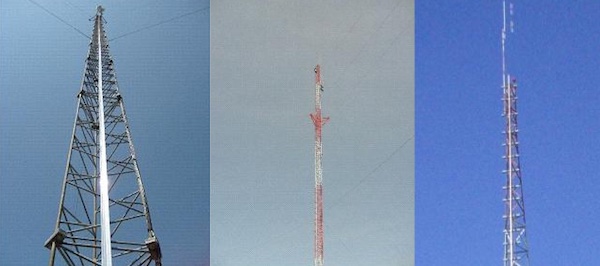
Unpainted guyed tower, Painted guyed tower, Painted guyed tower
In order to be able to quote you the right type of tower for your application (with or without installation), we need to have a reasonably good understanding what your tower is to be used for. Most established radio broadcasters, Telecommunications companies or commercial entities operating wireless networks have a clear understanding of what kind of tower might be needed, but this is often not the case for the first-time buyer.
During the past years, the demand for small to medium-size communication towers has dramatically increased to facilitate high-speed wireless Internet installations serving rural communities. Towers are also still purchased by HAM Operators to support the antennas for their amateur radio stations or by residents in rural settings to pick up TV and FM signals. Specialty towers may also be used for environmental measuring equipment, anemometer for wind-speed measurements, scientific research installations and many other applications. We would appreciate it, if you could provide us with the applicable answers to the questions below before you contact us for pricing and other information.
Free-standing (self-supporting) towers for light applications might be made of pre-galvanized + 16 gauge steel, diagonal angle iron horizontals or diagonals, often come in 8 - 10 ft sections where each section slip-fits into the next section. These towers might reach a height of up to 100 ft, and are typically not built to CSA approved procedures. Towers can also be constructed from tubular steel for the tower legs and solid rounds to be used as diagonals and horizontals. Stronger towers might use solid steel rounds for their legs and each all-weld constructed section could be up to 20 ft in length. Tall, heavy-duty towers are often constructed from hot-dipped galvanized steel where the tower legs are 20 ft in length and made of 120 degree angle iron with their horizontals and diagonals constructed of 90 degree angle iron. These towers are also called knock-down towers, since they are shipped in pieces to be field assembled on site.
During the past years, the demand for small to medium-size communication towers has dramatically increased to facilitate high-speed wireless Internet installations serving rural communities. Towers are also still purchased by HAM Operators to support the antennas for their amateur radio stations or by residents in rural settings to pick up TV and FM signals. Specialty towers may also be used for environmental measuring equipment, anemometer for wind-speed measurements, scientific research installations and many other applications. We would appreciate it, if you could provide us with the applicable answers to the questions below before you contact us for pricing and other information.
Free-standing (self-supporting) towers for light applications might be made of pre-galvanized + 16 gauge steel, diagonal angle iron horizontals or diagonals, often come in 8 - 10 ft sections where each section slip-fits into the next section. These towers might reach a height of up to 100 ft, and are typically not built to CSA approved procedures. Towers can also be constructed from tubular steel for the tower legs and solid rounds to be used as diagonals and horizontals. Stronger towers might use solid steel rounds for their legs and each all-weld constructed section could be up to 20 ft in length. Tall, heavy-duty towers are often constructed from hot-dipped galvanized steel where the tower legs are 20 ft in length and made of 120 degree angle iron with their horizontals and diagonals constructed of 90 degree angle iron. These towers are also called knock-down towers, since they are shipped in pieces to be field assembled on site.
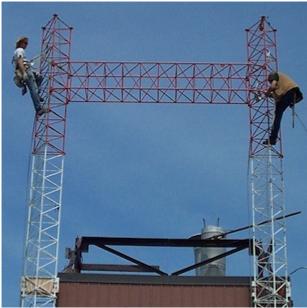
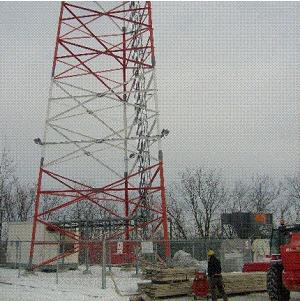
Left: Roof-top mounted H-frame tower
Right: Free-standing tower
Right: Free-standing tower
In order to serve you better, we need answers to the following questions:
Antennas
We Make Some Assumptions When We Quote
Without a geo-technical assessment, our engineers will not be able to design the right foundations or anchors and therefore, our quotation would assume the following:
We would also assume:
We charge upward of $5,000.00 for a basic soil analysis and geo-technical report if requested; Price depends on location, number of bore holes drilled and time of year.
- Where will the tower be located?
- What is the height of the proposed tower?
- Does the tower need to comply with CSA-S37-13 or other standards?
- Does the tower need painting in international orange-white?
- Do you require tower lights?
- When would you need the tower?
- Is the site accessible to 2-wheel drive vehicles?
- Is the site accessible to commercial concrete mixers and heavy equipment?
- Any special access restrictions we should be aware of?
- Would there be any restrictions concerning construction hours at that site?
- Are you the owner of the property and if not, who is?
- What type of tower are you looking for (freestanding, guyed or cantilever-mounted?
- Is a recent geological survey available?
- What is known about the soil conditions in general?
- How far below grade is bedrock?
- Are there hydro lines, phone lines or other obstructions close by that might impede the excavation for foundation or anchors or the erection of the tower?
- Who would be responsible for the removal of excavated material?
- Is hydro available on site?
- Is a communication shelter required and if yes, please specify.
- Do you need a wave guide bridge, cable tray or messenger cable from near the base of the tower to the communication shelter?
- Do you require anti-climb shields?
- Is a safety rail or another type of fall-arrest system required?
- Other
Antennas
- What types of antennas are used?
- What is the elevation where these antennas are to be mounted?
- What is their azimuth?
- What kind of transmission lines will be used?
- Will the transmission lines be fastened to the tower withstainless steel hangars or is ty-wrapping sufficient?
- Do you require ice guards/shields to protect antenna(s)from falling ice?
- Will you add more antennas in the future?
- Will there be other accessories mounted on the tower?
We Make Some Assumptions When We Quote
Without a geo-technical assessment, our engineers will not be able to design the right foundations or anchors and therefore, our quotation would assume the following:
- That the soil is non-acidic;
- Foundation and/or anchors are in loose, undisturbed soil;
- That self-supporting or freestanding towers up to 150 feet will have surface forming only of about 5-1/2";
- That no water or bedrock is encountered;
We would also assume:
- That all work is done before frost;
- That cable locating is done by others;
- That excavated material will be disposed off by others;
- That all permits will be obtained by others;
- That invoice(s) will be paid within 30 days of date of invoice.
- That financing charges of 2.5%/month would be paid on outstanding balance after 30 days;
We charge upward of $5,000.00 for a basic soil analysis and geo-technical report if requested; Price depends on location, number of bore holes drilled and time of year.